Heritage and vision
They were audacious in the way that only people who genuinely don't care about the establishment can be. Not provocateurs. Not rebels for the sake of it. Just people who wanted to feel something, to glide, to be free, and couldn't find what they were looking for. So they started asking questions. Trying to understand. Proposing something new. That's the approach we want to bring you, that's what connects all of us to them.
We had access to the fastest boats on earth, the best tools, the deepest technical knowledge. And still, something was missing. The thing Wharram felt when his plywood catamaran lifted off the water for the first time. The thing Newick was chasing when he rounded the edges of his hulls until the water stopped pushing back. The thing Birch knew, sitting on that little yellow boat, 98 seconds ahead of a machine twice his size, that a boat built with intention, with soul, with a clear answer to the question why, will always outrun one that wasn't. We think about them every time we make a decision.
Sure, the shapes have changed a little. The tools too. And honestly, they would have embraced every bit of it, they were never attached to the old ways. They were attached to the freedom, the technique, the glide, the softness, the speed, the fun, the sea. That part never changes.
Every time we're tempted to add complexity where simplicity would serve better. Every time the weight creeps up and we have to fight it back down. Every time we draw a line and ask ourselves, does this feel right? Is this honest? Would they recognise this?
They are our foundation. Older brothers who keep asking us the question that matters most: Does your work carry the meaning it deserves?
Mike Birch

Mike Birch was not a sailor. He was a gold prospector, an oil rig worker, a cowboy. He discovered the sea in his forties and entered the inaugural Route du Rhum in 1978 on a little yellow Newick trimaran — 36 feet, the smallest boat in the fleet.
He crossed the line just 98 seconds ahead of a 70-foot monohull after 3,500 miles at sea.
Ninety-eight seconds. After 3,500 miles. That image changed the history of offshore sailing.
Dick Newick

Dick Newick grew up building kayaks with his father and brother. By twelve, he was designing his own. He eventually ended up in the Virgin Islands and started shaping hulls the way a surfer shapes a board: by feel, by obsession, by listening to what the water wanted.
"People sail for fun, and no one has convinced me it's more fun to go slow than to go fast."
His hulls were rounded, organic, impossibly light. When a sailing magazine called his first trimaran "unsafe on any sea", he entered it in a race and beat almost the entire fleet.
James Wharram
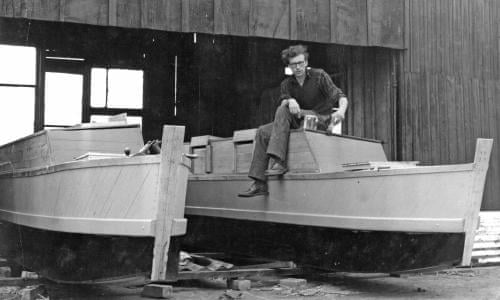
Somewhere in the fifties, a young man from Manchester named James Wharram decided to cross the Atlantic. He had no money, no sailing experience. What he had was a book about Polynesian canoes, a barn, and an obsession.
He built his first catamaran by hand — 23 feet of diagonal pine planks, glued together in a loft — and sailed it to Trinidad with two German girls and almost no provisions. The yachting establishment called it reckless. He called it obvious. The Polynesians had been crossing oceans in double-hulled boats for four thousand years.
"Watercraft and living on the sea is one of the arch-types of our sub-conscious. We design boats to fulfil this need by encouraging — through design — a lifestyle suitable for sea living, using simplicity as its basis."
For over 60 years, James Wharram and his team have been designing, building, and promoting affordable multihull boats that empower builders and sailors to take control of their own maritime destiny.
Their philosophy — that good design should be accessible, that boats should enhance life, that simplicity is the ultimate expression of elegance — resonates through every Wharram design. Today, they continue this legacy, but they need your support to preserve and expand this incredible work.
Visit Wharram Catamarans to explore their legacy and discover how you can support their mission to keep accessible boat design alive for future generations.
Jim Brown
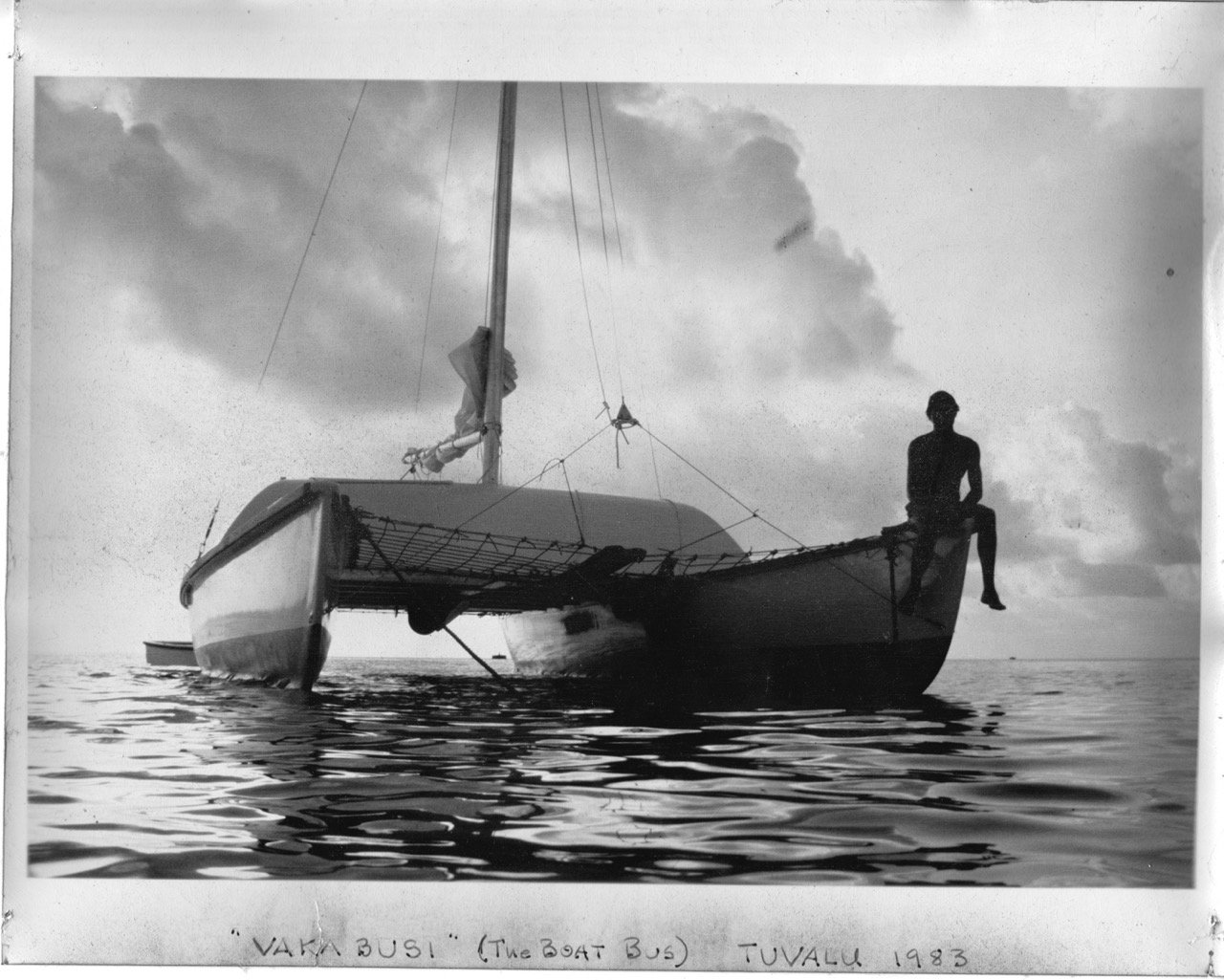
Jim Brown walked through that door. He built a Piver design in coastal California in the 1950s and cruised it on a 2,000-mile ocean voyage — his honeymoon with Jo Anna. In the 1960s, he developed his own series of trimaran designs — the Searunners — specifically intended for home construction.
"These guys jumped right out of the western tradition, grabbed some principles from a totally different genus — aircraft — and invented a hybrid vessel with hybrid vigor. I can own a trimaran, because it was designed for people like me to build, own and sail. That's a pretty amazing concept."
For decades, Jim Brown documented his designs, his journeys, and his philosophy about accessible multihull sailing with meticulous dedication. His work remains the reference point for anyone serious about understanding trimaran design and home construction.
Today, Jim Brown Beyond Mainstream continues this legacy. They need support to preserve and share his lifetime of knowledge. We encourage everyone to contribute to keeping this invaluable heritage alive for future builders and sailors.
Arthur Piver

Arthur Piver was a WWII pilot, a printshop owner, and an amateur sailor living on San Francisco Bay. In 1957, he started selling do-it-yourself trimaran plans through a company he called Pi-Craft. His designs were simple — marine plywood, lumberyard materials, hardware store fittings.
He crossed the Atlantic on his 30-foot Nimble in 1960. He crossed the Pacific on a 35-footer two years later. Piver was the one who opened the door. He proved that the cruising trimaran wasn't a specialist object reserved for engineers and professionals. It was something you could build in your backyard, sail across an ocean, and make completely your own.
Chapter 2 — Savoir-faire

We didn't come to this from the outside.
IMOCA. ULTIM. Jules Verne contenders. Gitana 18. Ferrari Hypersail. For the past twenty years, we have been inside the rooms where the fastest boats on earth are designed, working with Guillaume Verdier's team, applying the same CFD tools, the same structural logic, the same obsession with what water does to a hull at speed.
We know what fast feels like. We know what it costs, technically, structurally, humanly. But there's something those boats don't have. Something that got lost somewhere between the carbon pre-preg layups and the hydraulic load calculations.
The glide.
Chapter 3 — The Breakthrough
The paradox was always the same.
The boats with soul weren't fast enough.
The fast boats had lost their soul.
For years, we assumed that was just the nature of the trade-off. That you picked a side. Turns out, the problem wasn't the physics. It was the approach.
The Ipsum 45' is that project. Organic forms, derived from the same Polynesian tradition those builders drew from. Hulls designed by Guillaume Verdier and optimized with the same CFD tools used on ULTIM trimarans. And a construction model that brings the spirit of Piver's do-it-yourself plans into the 21st century.
Timeline — 20 years
From Loic
I've been asked many times why I'm doing this. Honest answer — I couldn't help it.
I've spent twenty years on the cutting edge. Jules Verne contenders, Ultims, record machines. Incredible engineering. Not always pleasurable.
But I kept coming back to those guys. What they had — all of them — was the conviction that the right shape, built the right way, by someone who actually cared, would feel fundamentally different on the water.
Probably pretentious. Definitely obsessive. But I couldn't not try.
— Loic